
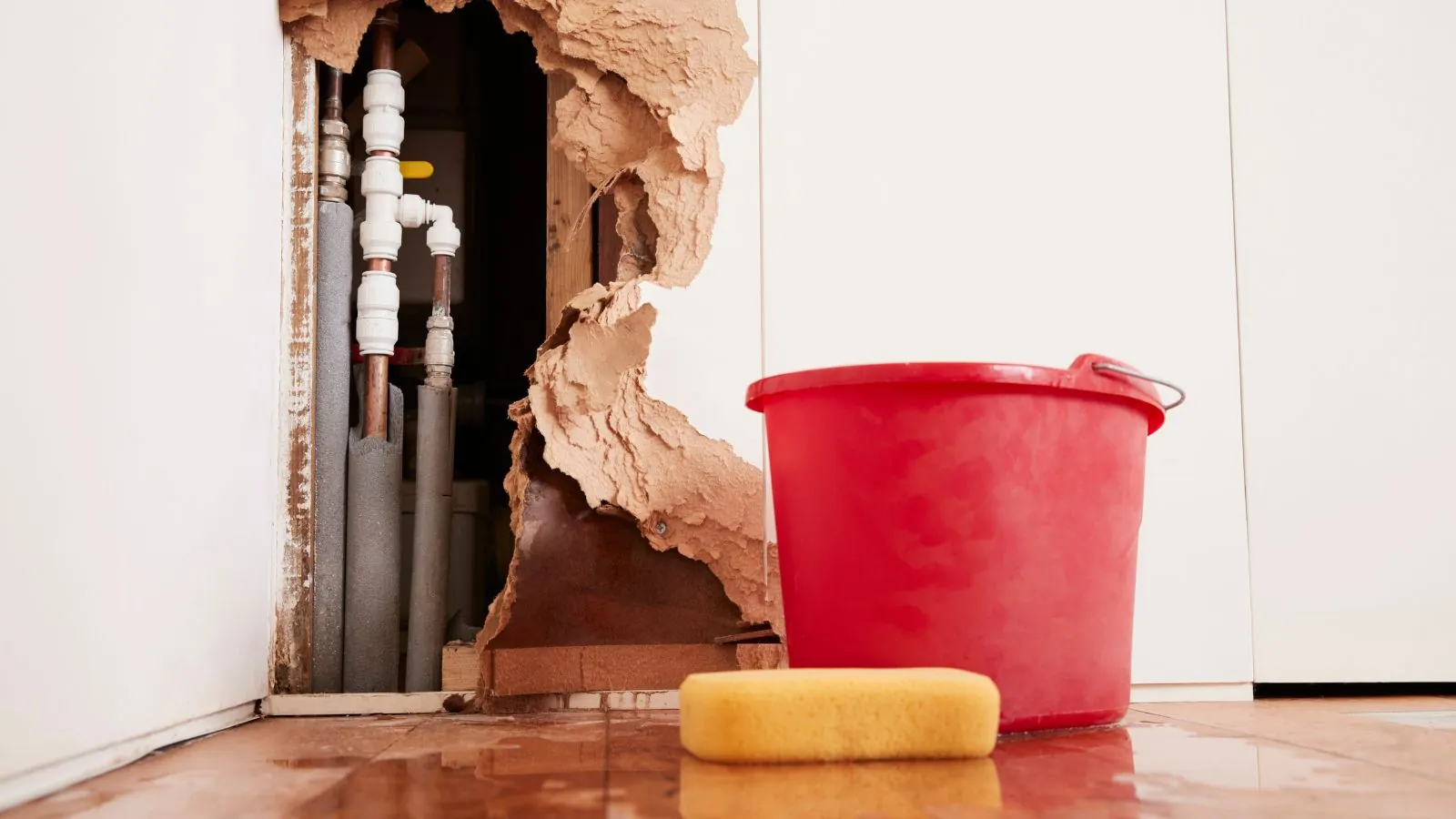
In a burst pipe or a failed fixture, minutes matter. A supply line can release hundreds of gallons an hour, and the only way to stop it is to close a valve.
Most homeowners cannot say where their main valve is. This guide shows where to look, how to test it and what to do if it will not turn.
Where the main valve usually is
The main valve sits where the water line enters the house. In many homes that is a basement wall near the front, a utility room, a garage or a crawl space. Look near the water meter and the pressure regulator, if there is one.
In some homes, the line enters through a slab, and the valve may be in a closet or a cabinet. Follow the pipe from the meter, and look for a handle or a round wheel.
Gate valves and ball valves
| Valve | What it looks like | How to close it |
|---|---|---|
| Ball valve. | Lever handle. | Turn a quarter turn so the lever is crosswise to the pipe. |
| Gate valve. | Round wheel. | Turn clockwise until it stops, without forcing it. |
| Curb stop. | Underground, at the street side. | Needs a special key. Call the water department. |
Ball valves are easier to use and less likely to stick. Gate valves can seize with age, so test them gently once a year.
Test it now, not during an emergency
Find and label
Tag the valve with its location and tell everyone in the house.
Close and open
Close it, open a faucet to confirm the flow stops, then reopen the valve.
Check for leaks
Look at the valve stem for drips after you reopen it.
Replace if stuck
If it will not move, ask a plumber to replace it.
A stuck valve is a risk. If it does not turn smoothly, do not force it, because it may break. A plumber can replace a failing valve before an emergency.
If the interior valve does not work
The next option is the curb stop, which controls the line at the street. In Parsippany-Troy Hills, the township Water Department can be reached at (973) 263-7099. In other towns, call the local water department or utility.
The curb stop usually needs a special key, and a utility often limits who can operate it. Call early, and tell them it is an emergency.
Other valves worth knowing
- Fixture shutoffs under sinks and behind toilets.
- The water heater's cold inlet valve. See the water heater page for steps.
- Washing machine valves behind the washer.
- Outdoor hose bib shutoffs inside the house.
Closing a fixture valve can solve a small leak without cutting water to the entire house. Know where each one is.
After the water is off
Open a faucet at the lowest level to drain the line, and one upstairs to release air. Keep clear of water near outlets. Photograph the damage and call for extraction. The burst pipe page explains the next ten minutes.
Practice makes the emergency calm
Run a short drill with your household. Show each adult where the main valve is, how it turns and which way is closed. Children old enough to help can learn it too. A valve everyone knows is a valve that gets closed in the first minute.
Write the location on a card and keep it with your emergency numbers. If you rent, ask the landlord where the valve is, and keep that answer in your phone. A tenant who can close the main can prevent a large loss.
Signs that you should close the main right away
A pipe is spraying or flowing
Close the main first, then deal with the rest.
Water is coming through a ceiling
A supply line upstairs may be the source.
The meter is spinning with everything off
A hidden leak is likely, and the main stops the loss.
You are leaving for a long trip
Closing the main reduces the risk of an unattended leak.
When to call a plumber, and when to call a restoration crew
The plumber stops the leak at the source and repairs the pipe. The restoration crew extracts the water, removes wet materials and dries the structure. The two jobs can happen at the same time, and calling both saves hours.
If you cannot find the main or it will not close, the township Water Department is the next call. Tell them it is an emergency, and give the address.
What to do if you are away when it fails
If a leak starts while you are away, the main may be the only fast fix, and someone else has to close it. Give a trusted neighbor or relative the location of the valve and the house key for emergencies.
Water leak sensors that send alerts to your phone can shorten the delay. Some models can close a motorized shutoff valve automatically. They are worth considering if you travel often.
Crews that follow ANSI/IICRC S500 treat uncontrolled supply-line flow as a Category 1 event at first, which is another reason to close the valve quickly. Finally, test any motorized or smart shutoff you install. A device that fails silently gives false comfort. Put a reminder in your calendar to cycle the valve and check the batteries twice a year. Note the date of each test on a card near the valve.
Water service in Parsippany-Troy Hills and nearby
The Township of Parsippany-Troy Hills runs its own Water Department, which draws on groundwater. Its phone is (973) 263-7099. The township code treats the service pipe from the curb stop to the house as the owner's side.
Nearby towns each have their own utilities. In Mountain Lakes the borough Water Department supplies the town, and in East Hanover the township Water Department handles utilities at 973-888-6080.
Questions about this topic
Usually on a basement wall near the front of the house, close to the meter.
Follow the pipe from the water meter, and look in the basement, utility room, garage or a closet.
Only with the right key and permission from the utility. Call the water department.
Older gate valves can corrode. Do not force it, and ask a plumber to replace it.
The township Water Department at (973) 263-7099 handles the public side of the system.